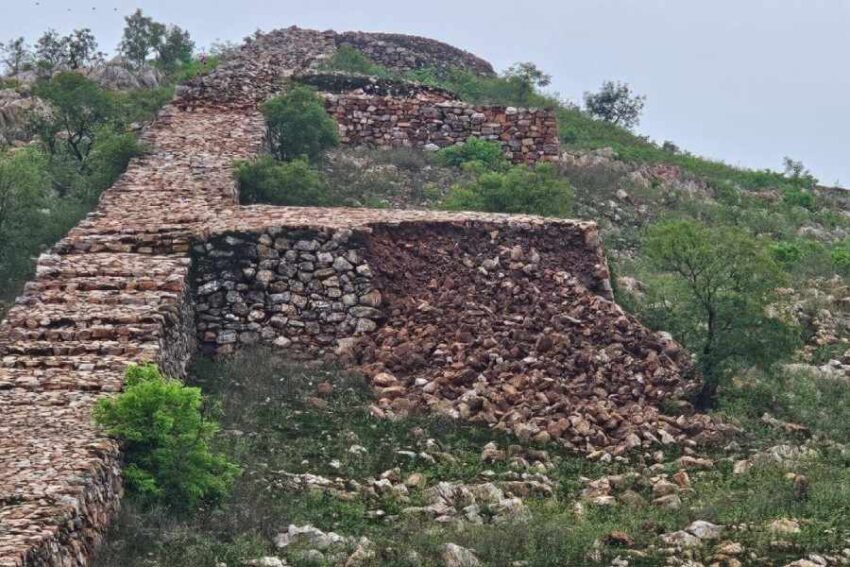
A section of India’s oldest Cyclopean Wall collapsed in Rajgir after heavy rains in Bihar. This has raised questions about the maintenance of the 2600 year old structure, which is being considered for UNESCO‘s World Heritage List.
Two sections of the wall, including a section 20 feet long and 12 feet wide, collapsed near Banganga after heavy downpour in Nalanda. A team from the Archaeological Survey of India (ASI) visited the site after the rain stopped.
An ASI official said, “Cyclopean Wall has collapsed at two places. It rained incessantly in the area. People in the villages there also said that there was a lightning strike nearby. We will assess the damage, prepare an estimate and repair the priceless structure as soon as possible,” he told The Telegraph.
Built around 2,600 years ago, the Cyclopean Wall is considered one of the oldest protective masonry or stone fortifications in the world. It was built of unworked and semi-worked stones without the use of mortar.
The 45 km long wall, ranging from 3ft to 15ft high and 12ft to 14ft wide, ran over the hills and surrounded Rajgriha (Rajgir), the capital of the ancient Magadh Empire, to protect it from invasion. According to Buddhist texts, the fortification had at least 24 gates with bastions and watchtowers.
Soldiers patrolled around the wall 24/7. The inside of the wall had small recesses or hollows to protect security personnel from the rain and sun.
The wall survived the vagaries of the weather and came under the protection of the ASI around 1905. It underwent a major repair in 1944 under the supervision of then ASI director general Mortimer Wheeler, and several more minor repairs were carried out over the years.
Shanker Sharma, professor of ancient Indian history at Magadh University and a former ASI officer, said, “”This is one of the oldest examples of defensive architecture. It is amazing as it was built with the help of stones weighing from a few kilograms to a ton. It protected not only the rulers but the entire city and its inhabitants. The number of stones used in the structure shows the knowledge of stone mining that was common at that time.”
Sharma said there are similar structures in Europe and South America, some of which may be older than the Cyclopean Wall at Rajgir, but none with such a large, extensive and well-thought-out construction process.
The Rajgir structure derives its name from cyclopean masonry, a construction technique using huge blocks of stone without mortar. This type of construction can be found in Crete, Tiryns, Delphi, Attica, Ireland, Italy, Machu Picchu (Peru) and parts of South America.
The Cyclopean Wall at Rajgir had deteriorated over the last few years. It was broken and destroyed in several places. Gurdwara Nanak Sheetal Kund was built close to the wall in violation of the Ancient Monuments Archaeological Sites and Remains Act of 1958. The Act defines a ‘prohibited area’ of up to 100 meters from protected monuments where no construction is allowed.
“There are several problems with the conservation of the Rajgir Cyclopean Wall. We are facing a shortage of resources and manpower. We are protecting the parts of the wall that are easily visible but the parts that are out of sight or in forested areas are being neglected. Bushes and trees have overgrown in several parts of the massive wall, weakening its structure, and seeds have sprinkled all over the hills, many of which have fallen on the wall, sprouted and grown. This was a very foolish practice to adopt in an area full of ancient monuments,” said ASI official.