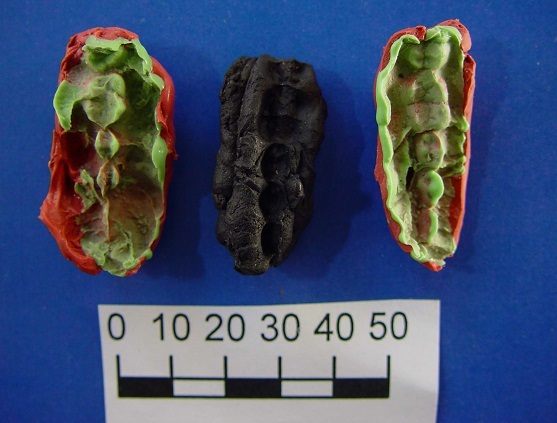
Our ancestors chewed gum just like we do, but their ancient gum was actually a tarry tree resin, and we can be sure it didn’t taste anything like ours.
Samples of this birch ancient gum with 10,000 year old tooth marks still on it were discovered in Sweden, but a recent study has revealed more about what prehistoric young people ate and other activities they did with their teeth.
The study, published in the journal Scientific Reports, says the gum, unearthed in the 90s at the archaeological site of Huseby Klev on Sweden’s west coast, was probably chewed by children and teenagers as young as five years old. The fragments contained animal tracks that revealed they had eaten wolves, arctic foxes and a type of water snail called periwinkle, among other birds and fish. It seems that the youngsters also enjoyed nuts and crab apples shortly before they put the gum in their mouths, which they may have done for a variety of reasons.
Emrah Kırdök of Mersin University in Türkiye, lead author of the study, said, “They were chewing these pieces of pitch to create new tools, mostly in material culture. For example, they might make an axe out of flint and wood or use wood glue to seal a leak in a boat. It could almost resemble today’s chewing gum, except for the sooty color of the substance. It would have been produced by burning the bark and scraping the resin from a rock.”
But the main focus of the study was not the chewing gum itself or why Stone Age people chewed it; the researchers investigated what the chewed resin still contained thousands of years later and what this revealed about prehistoric health and culture. In addition to traces of things eaten during this period, such as brown trout, dove, mallard and red deer, the team discovered dozens of bacteria associated with gum disease and tooth decay, indicating “poor oral health during the Norse Mesolithic“. This is information that we might have assumed but was not so obvious before.
Birch tar is probably not responsible for this poor oral health, says Kırdök. Instead, microbes would have entered the body through the frequent use of teeth as tools. The ancient Scandinavians used their teeth to make clothes from animal furs and to carve bones into various utensils. We also understand that they bit mistletoe, a plant that children tied to arrowheads to make them poisonous. “We are capturing a moment in the Stone Age in great detail,” says Kırdök.
It is even thought that its antimicrobial properties may help to reverse some of the damage done to teeth by birch tar.
It is also possible that chewing the tar may have relieved toothache, or perhaps it was chewed for pleasure. Birch tar is a natural antiseptic and is still used for medicinal purposes today. However, it will not be enough to stop tooth decay.